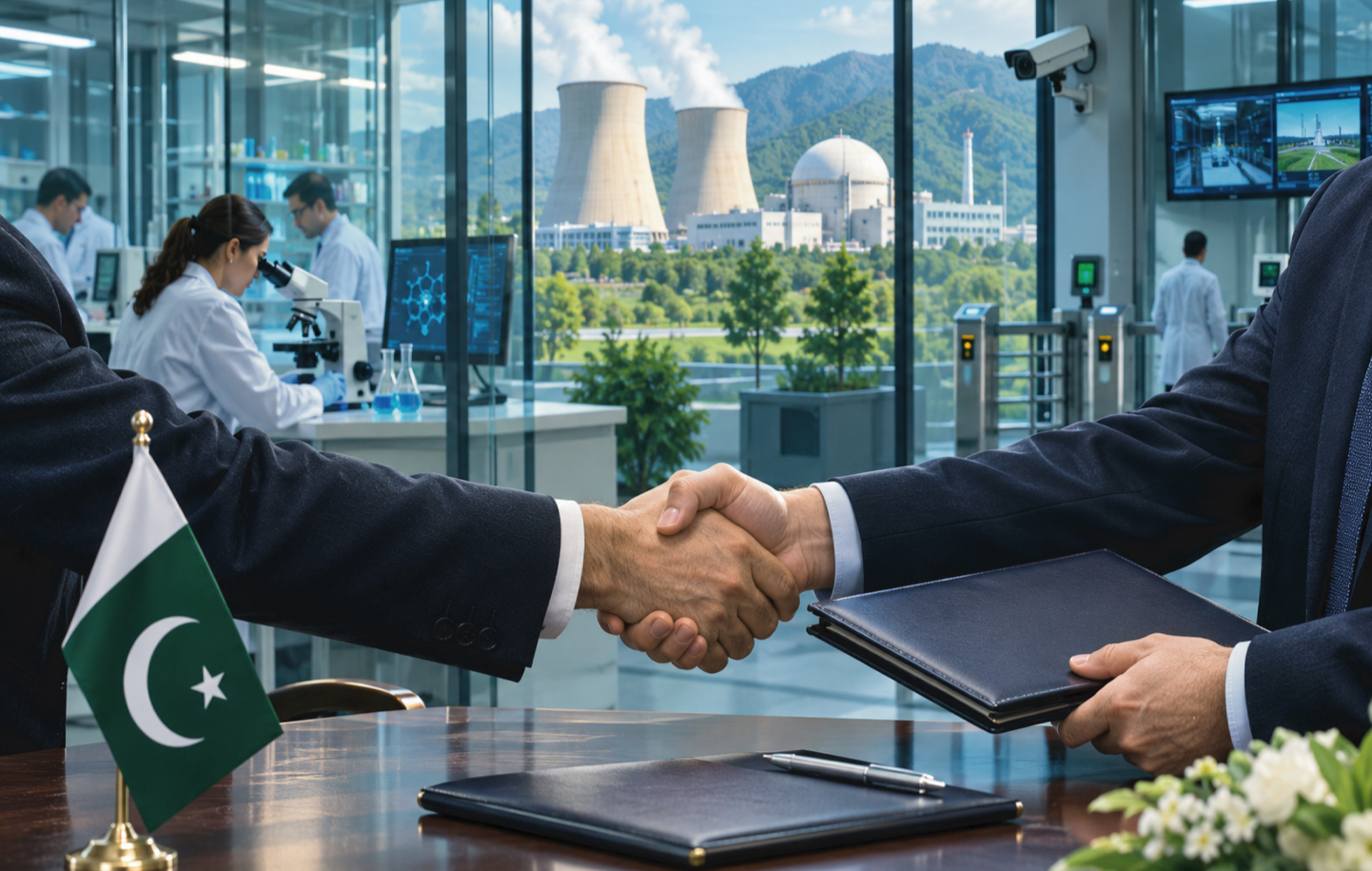
International cooperation is crucial to preserving nuclear security as nuclear research and technology advancement into the fields of energy, medicine, agriculture, and other peaceful applications. The International Atomic Energy Agency supports Member States via advisory missions, technical support, specialized training and international direction.
As Pakistan has been a founding member of the IAEA since 1957, there are several opportunities to enhance domestic institutions, exchange information and participate in international nuclear security efforts within the Agency as part of its future activities.
The next level of this partnership can be analyzed in the light of recent Pakistan’s interactions with the IAEA, as well as the upcoming meeting of the Nuclear Security Support Centers (NSSCs) in Islamabad in November, and the IAEA’s first International Physical Protection Advisory Service (IPPAS) mission in October 2026.
National regulatory bodies, technical associations, and specialized training facilities are all part of Pakistan’s nuclear security framework. The Pakistan Atomic Energy Commission (PAEC) and other relevant institutions assist in implementing nuclear security agreements, while the Pakistan Nuclear Regulatory Authority (PNRA) is responsible for nuclear regulation.
A key step forward in Pakistan’s involvement with international nuclear security review procedures was the conclusion of its first IAEA IPPAS mission on October 9, 2026. The mission, which PNRA organized in collaboration with PAEC and other national organizations, evaluated Pakistan’s legal and regulatory system and reviewed the KANUPP Decommissioning Project.
Through these missions, participating nations can obtain professional advice and find ways to enhance existing agreements in compliance with pertinent international guidelines through these missions. The IPPAS team finds that Pakistan has put in place a strong nuclear security framework for the physical protection of nuclear material and nuclear infrastructure; at the location they visited, this framework was suitably applied.
The current capacity building infrastructure of Pakistan adds value to the experience and knowledge of the country, the region, and the world on nuclear security.
Skilled personnel and organizations are needed to maintain nuclear security, and to offer specific training. The PNRA has set up Pakistan’s National Institute of Safety and Security (NISAS), which is providing technical assistance, training and education on nuclear security.
NISAS’ participation in international capacity building was strengthened in 2022, specifically as an IAEA nuclear security collaborative center for education, training and technological support. Specialized training and professional development are also provided by the Pakistan Center of Excellence for Nuclear Security (PCENS). These initiatives as a whole offer a basis for gaining expertise in security procedures and preparedness.
Pakistan is also set to hold its annual training program of the International Network of Nuclear Security Training and Support Centers (INNSTC) from 23 – 26 November 2026. To improve technical skills, the meeting provides a chance to network training facilities, share experiences, and discuss possible pathways.
Its potential impacts include continued professional collaborations and cooperative training programs that can facilitate participating institutions in resolving mutual issues.
Pakistan and IAEA cooperation is significantly framed by its civilian nuclear program. During the Agency’s 70th General Conference in September 2026, Pakistan highlighted the contributions of its six operational nuclear power reactors, along with identifying almost 15 million tons of emissions of carbon dioxide.
Pakistan also confirmed the signing of its safeguards agreement with the IAEA and the C-5 nuclear power project advancement. Pakistan’s ongoing collaboration with the IAEA further enhanced the opportunities to improve technical expertise and uphold institutional procedures in line with pertinent international commitments and guidelines
Another aspect of Pakistan’s cooperation with the IAEA is technical collaboration in sustainable development. During the 70th General Conference, Pakistan demonstrated that, under its Sixth Country Program Framework, four national technical cooperation projects are in process.
CPF was signed with the IAEA from 2026 to 2031 and serves as the framework for the medium-term planning of technical cooperation between a Member State and the IAEA. It identifies priority areas where resources for technical cooperation and nuclear technology transfer will be allocated to meet national development objectives.
For Pakistan, the management of water resources is especially important. Groundwater mapping and the scientific evaluation of water resources are supported by the application of isotope hydrology. Pakistan has also emphasized PINSTECH’s involvement in the Global Water Analysis Laboratory Network and its function as an IAEA Collaborating Center for water-resource management.
Opportunities to share scientific knowledge and advance technological capabilities are created by such collaboration. These initiatives are enhanced by human resource development. The significance of fostering future scientific expertise is seen in Pakistan’s funding of the IAEA’s Marie Skěowska-Curie Fellowship Program and Lise Meitner Program, as well as PIEAS’s commitment to nuclear science education.
These programs support the peaceful uses of nuclear technology while expanding Pakistan’s interaction with the Agency.
The next phase of the IAEA-Pakistan nuclear security cooperation should focus on three integrated areas in the future. First, the importance of institutional learning should remain the same. IPPAS mission is an opportunity to consider existing arrangements and how things could be improved further.
Secondly, any specialized capacity building requires ongoing investment in technical infrastructure, professional development, and information dissemination. By enhancing professional skills and participating in global training networks, Pakistan’s training institutions can help to achieve this goal.
Third, there should be more focus on new technology issues. As these digital systems become vital to nuclear security planning and training, cybersecurity risks increase, and as AI advances, the need will increase for security planning and training. Collaboration with the IAEA and other Member States can help develop a shared experience and expertise to address new technology challenges.
In order to achieve sustainable development of IAEA-Pakistan nuclear security cooperation, international participation will play a pivotal role in the process. The forthcoming NSSC meeting and the IPPAS mission provide opportunities to enhance technical cooperation and professional interaction.
Expansion of these projects will enable Pakistan to also expand its role in international cooperation, responsible utilization of nuclear science and technology, while enhancing nuclear security capabilities.