
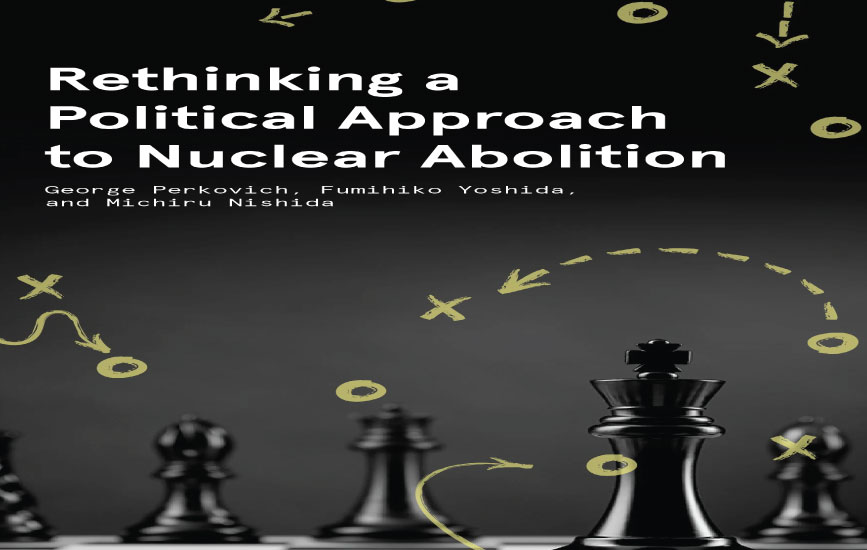
In 2022, G20 leaders announced at a summit in Bali, Indonesia, that “the use or threat of use of nuclear weapons is prohibited,” repeating the declaration made by Soviet leader Mikhail Gorbachev in 1986 and then-US President Ronald Reagan that “a nuclear war cannot be won and must never be fought.” The writers George Perkovich, Fumihiko Yoshida, and Michiru Nishida of the book Rethinking a Political Approach to Nuclear Abolition support this conclusion, since no one can predict if a limited nuclear conflict can be prevented from getting worse, and if a full-scale conflict breaks out, the repercussions would be catastrophic. This book emphasized the need for policies based on political security realities rather than the quantity or quality of nuclear weapons to confront the rapidly expanding nuclear arsenal, rising nuclear threats, and widening geopolitical divides.
To prevent nuclear war and other existential military dangers, the book argues that countries must prioritize politics over nuclear weapons. Many participants in nuclear policy discussions support force-building without recognizing the risks of unintended escalation or mutual stabilization, and they want nuclear abolition without addressing political-security situations. The United States nuclear posture intends to protect itself and its allies from possible attacks by China, North Korea, or Russia. It is not possible to compel any nuclear power to disarm on its own, as doing so would have domestic repercussions.
This resistance to disarmament or even balanced mutual restraint is a reflection of the rivals’ unwillingness to negotiate both internationally and domestically. Additionally, it expresses concern that, possibly with the use of advanced technologies that allow for war without escalation, one nuclear power may attempt to overthrow or alter the governments of other nations. Worst-case policymaking and military-industrial complexes further obstruct the balanced discussions required to stabilize competitions and eventually pursue disarmament. Today’s political circumstances are more complicated compared to the Cold War; there are more factors, leaders, and nuclear actors that need to work together to establish long-lasting constraints. Proponents of nuclear weapons frequently use the threat of abolition to gain more control and portray opponents of restraint as unsophisticated.
Almost all arms control agreements between the US and Russia have been withdrawn from or suspended. North Korea is diversifying and increasing its nuclear weapons. Unstabilized nuclear competition is practiced by these states in spite of its terrific danger, high cost, and futility. In order to overcome the political dynamics of unstable competition, the authors emphasize that a practical coalition is needed. Governments and civil society actors who support disarmament must collaborate with those who value nuclear deterrence to negotiate policies that stabilize it before eventually achieving disarmament. Although deterrence can never be completely stabilized due to the possibility of changes in the status quo and possible nuclear responses, steps can be taken to reduce costs and risks. Recognizing mutual vulnerability is necessary for stable nuclear rivalry since adversaries’ ability to cause unbearable damage cannot be eliminated by offensive first strikes or missile defences.
When unilateral disarmament is not offered as a substitute, it is politically simpler to comprehend the boundaries of deterrence. In situations where several countries support restraint, even if it is not complete abolition, coalitions supporting stabilization can be developed. The book outlines one major objective: putting an end to nuclear overkill, which is defined as arsenals that endanger citizens and the environment excessively and are more driven by bureaucratic interests than by logical deterrence. As a new expert panel established by the UN is entrusted with this task, nuclear states and alliances should evaluate the impact of conflict scenarios and modify their postures accordingly. Leaders should specify whether their plans create excessive force, identifying that those responsible for nuclear use often think differently from theorists and Planners.
The book outlines six guidelines to operationalize stabilization.
- Supremacy quests lead to countermeasures, which make everyone worse off. While politics prevent abolition, nuclear risks can be reduced by creating a policy on joint recognition and vulnerability.
- Preemptively destroying the nuclear forces or command systems of enemies should be avoided if counterforce targeting leads to launch-on-warning plans and destabilizing arms racing.
- To avoid stimulating preemptive attacks or arms races, restrict the country’s missile defenses against second-strike deterrents.
- It is important to understand how unintentional escalation risks can be reduced, as multiple-use command and delivery systems might provoke mistaken nuclear responses.
- By codifying restraints and planning compliance assurance mechanisms, one can bolster confidence in competitors’ political intentions.
The possibility is demonstrated by historical example: early attempts by American and European civil society to stop the U.S.-NATO-Soviet arms race in the early 1980s were unsuccessful, but within ten years, considerable reductions in deployed nuclear forces were made possible by confidential assurance and leadership changes. Certain communities and leaders may still be able to identify present threats and, when political circumstances permit, they can start establishing mutual restrictions, as much of the progress has been reversed. U.S. presidents, including ardent defence hawks like Richard Nixon and Ronald Reagan, through covert communications with their communist counterparts, concluded extensive arms control treaties.
This book also discusses the important role of high-level dialogue in moving towards nuclear abolition. The authors argue that asking fundamental questions is necessary to stabilize nuclear competition. To impose regime change or seize territory, will nuclear-armed states forego using force? To stabilize relations and reduce nuclear war risk, how do leaders justify avoiding high-level dialogues? Leaders of non-nuclear states must ask these questions, as they are mostly at risk of escalated conflicts. Fruitful dialogues increase the possibility of clarity, validating them to prepare defensive actions or assuaging worst-case assumptions. Dialogue can reveal whether mutual restraint is possible, as adversaries’ intentions are not clear. This applies as much to Donald Trump, Xi Jinping, Vladimir Putin, and Kim Jong Un. The book also argues that creating a political environment by the international community, where states feel “equal and undiminished security” without nuclear weapons, abolition remains a utopian fantasy. This aligns closely with the realist school of thought but adds a constructive layer by suggesting how these political conditions can be intentionally cultivated.
Nuclear abolition, unstabilized deterrence, or stabilized competition: this book explores these three paths forward. According to the authors, the most pragmatic near-term solution is a middle-ground approach of stabilized competition. While actively reducing intentional and accidental risks, this pragmatic strategy acknowledges the reality of nuclear deterrence. By prioritizing politics and people over quality and quantity of nuclear weapons, the authors argue that it is politically more challenging to prevent nuclear war and disarmament than many proponents and opponents identify.
The authors provide a comprehensive and timely political framework of nuclear abolition for the scholars and practitioners engaged in arms control, deterrence theory, and disarmament diplomacy, but in the current geopolitical scenario, as the United States-Israel military strikes on Iran and the Budapest memorandum failure in the Russia-Ukraine conflict indicate that nuclear deterrence remains the ultimate tool for a state to protect its sovereignty and dissuade an enemy. The author’s idea, nuclear abolition, is utopian and not possible to implement in the evolving global security architecture. States are now acquiring and expanding their nuclear weapons to protect themselves rather than to disarm. A clear example of disarming itself in exchange for security assurance in the Budapest memorandum is the critical flaw in the abolition argument, as it ultimately failed in the Russia-Ukraine conflict and sent a clear warning to middle powers that nuclear deterrence remains a credible defense against conventional invasion or regime change. In the contemporary era, nuclear weapons are a necessity to protect the sovereignty and territorial integrity of the state. Because of the realist requirement of deterrence, the political path to abolition remains undermined and impossible.