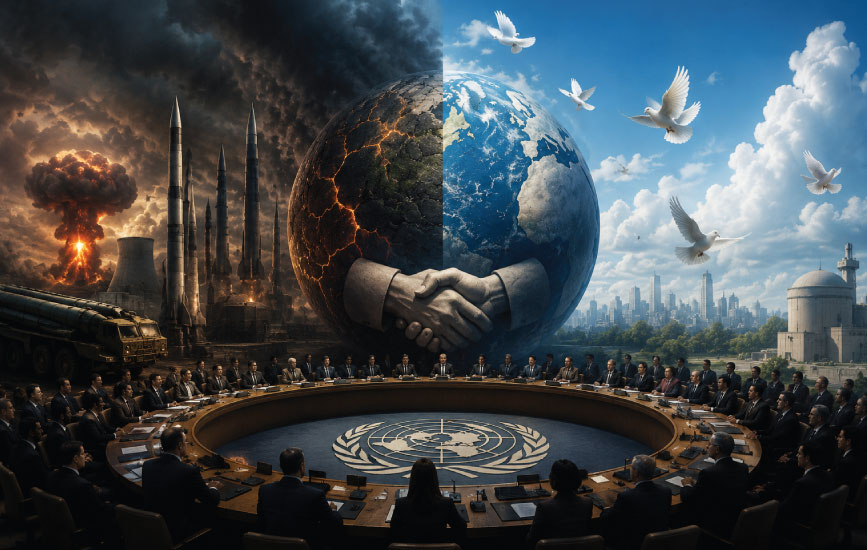
The United Nations’ 11th Nuclear Non-proliferation (NPT) Review Conference (RevCon) began on April 27 and will continue until 22 May. The RevCon brings together all member and observer governments, as well as intergovernmental and civil society organizations, to assess the implementation of the treaty. Article 8 of the NPT mandates that the RevCon be held every five years.
Two prior RevCons in 2015 and 2022 were unable to reach an agreement on a final document. By the time of this year’s Revcon, the multilateral system is under severe strain, and the world is becoming increasingly fragmented and chaotic. While disarmament talks are dwindling, nuclear weapons are growing, and wars are being justified in an effort to achieve a sense of victory.
The UN Charter is ignored, states’ borders are violated, and new technology has entered the conflict. Many states view nuclear weapons as a tool to protect national security from foreign aggression. In this environment, whether states will be able to navigate a wide range of contentious issues and reach a consensus final document that strengthens and reaffirms support for the treaty and lays out specific action steps for the next five years.
It is anticipated that negotiations at RevCon 2026 are expected to be complicated and the conference may end with yet another failure to establish a resolution.
There is a lot of tension in the diplomatic environment as the treaty discussions proceed further. There will continue to be disagreements over the war in Ukraine and its consequences for nuclear energy infrastructure in the region. Disagreements over Iran’s nuclear program and its management of enriched uranium and verification procedures. US-Israel strikes on the Iranian nuclear facilities, and concerns about the safety of nuclear material during the wars.
Concerns within the US-led alliance system regarding China’s modernization of its strategic force will also be part of the discussion, concerns of many states regarding the forward deployment of US tactical nuclear weapons in Europe, and Russia’s announcement of deployment of its TNWs in Belarus, and the P5 states’ failure to hold substantive nuclear disarmament negotiations.
During this RevCon, geopolitical divisions between nuclear-weapon states are becoming increasingly intense. The P5 states (UK, US, Russia, China, and France) already have clashes and mistrust regarding nuclear force modernization, the future of strategic stability frameworks and transparency measures.
Along with this, discussions in the North Atlantic Treaty Organization (NATO), specifically among France, the United States, Poland, and other European allies, over deterrence posture, burden sharing, nuclear deployments, and defense spending, also highlight the fractures in the European security framework. These conflicting trends appear to create an obstacle with regard to collaboration and mutual understanding at the RevCon meeting.
The ongoing arms control crisis has increasingly challenged the credibility of the NPT. With the expiration of arms control agreements, particularly the suspension of the obligations under the New Strategic Arms Reduction Treaty, the US and Russia can now expand their strategic arsenals without obstacles. This is also an alarming concern that the US’s recent announcement to resume nuclear testing.
Additionally, France has demonstrated that it is modernizing its strategic forces and collaborating closely with its allies to establish the credibility of nuclear deterrence. Conventional asymmetries are exacerbated in some conflict-prone areas due to the collapse of the arms control framework between the US and Russia.
In the Asia-Pacific region, South Asia, the Middle East, the Korean peninsula, and Eastern European states are actively engaged in an arms race motivated by security concerns. As a result, the confidence in the principles of the NPT continues to erode and states’ dependence on nuclear weapons is greater than before.
The threshold for the use of nuclear weapons has been lowered by new technologies like cyber warfare capabilities, AI-led drones and Lethal Autonomous Weapon Systems, nuclear hypersonic glide vehicles, hypersonic cruise missiles, global prompt strikes, states ‘ deliberate supremacy in space and cyberspace, anti-satellite and surveillance systems and the blurring of the thin line between TNWs and high-precision advanced conventional systems.
The Treaty on the Prohibition of Nuclear Weapons is also part of the RevCon discussion. The fundamental tenet of this treaty is the humanitarian impact of nuclear weapons, which was promoted by both the public and civil society organizations in an effort to eradicate nuclear weapons from the world. This treaty might not be able to create a bridge between the security requirements of governments and emerging technologies.
Supporters of the TPNW and the nuclear-weapon states appear to remain politically divided. The TPNW might not be able to close the gap between NWS and NNWS without incorporating discussions on new regional conflicts and nations’ security concerns. In short, the NPT process is attempting to operate while the environment that supports it is deteriorating.
The NPT’s strategic and institutional framework must be modified to contemporary realities. Reducing the gap between NWS and NNWS requires addressing their concerns and maintaining a balance between states’ security requirements.
Supporters of the TPNW framework argue that disarmament initiatives should ensure equitable and undiminished security for all states and prevent any state or group of states from gaining a military edge over others, as viewed in the recent conflicts.
Member states must continue to engage in productive discussions and focus on areas of agreement on the NPT as they attempt to reach an outcome document. Key states should stop criticizing each other and start focusing on the difficult task of developing practical content that can be supported by all parties.