

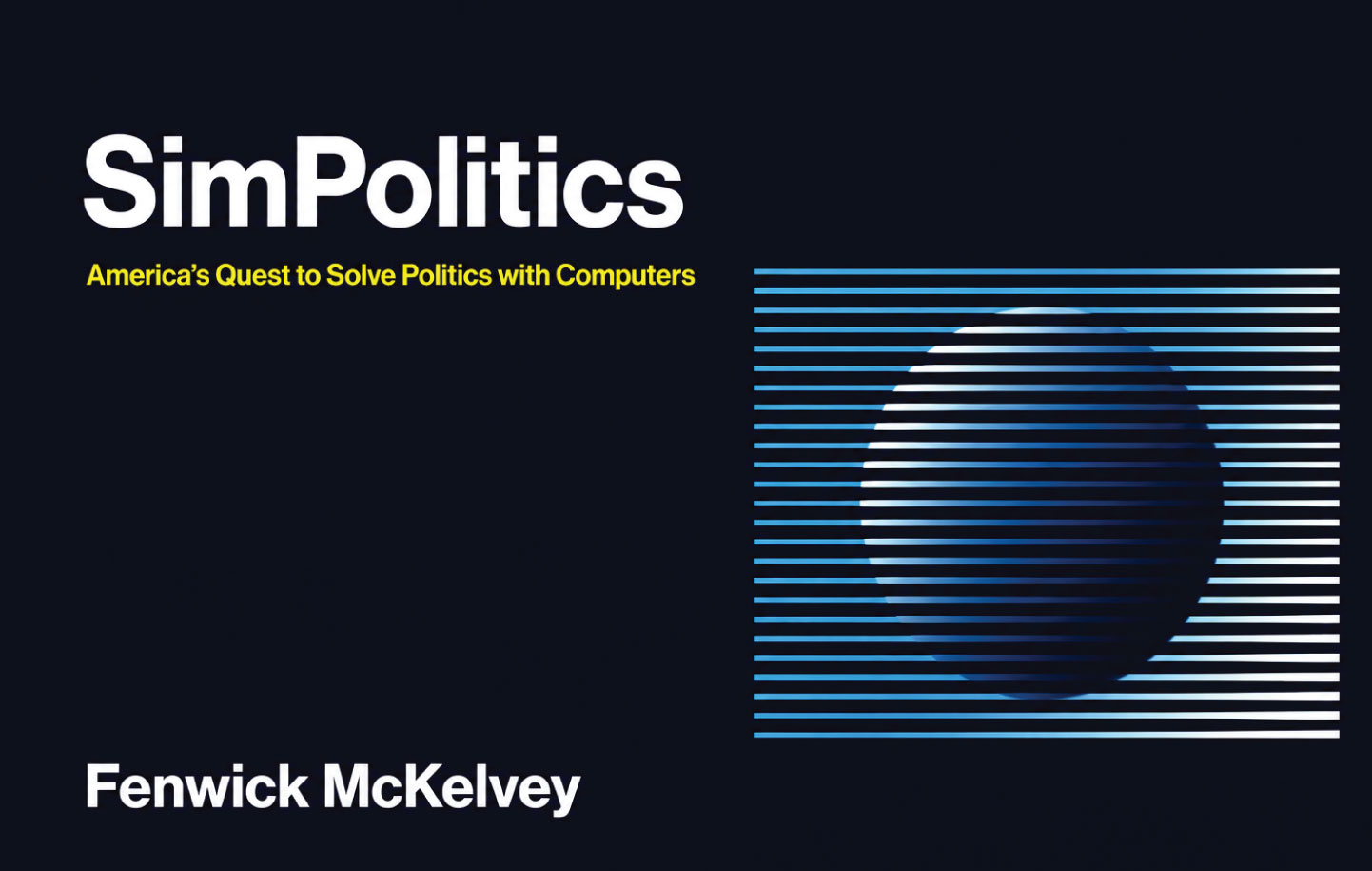
In his book SimPolitics: America’s Quest to Solve Politics with Computers, Fenwick Mckelvey critically examines the use of computer simulations and political forecasting in contemporary American history using primary archival evidence, historical case studies, and theoretical analysis. The author questioned preconceived notions about the sudden novelty of computerized social control and computational politics.
The core argument of the book is that the computing has been used to build a “computational imaginary of politics” and that is being supported by the institutional, technical, and historical data that frames how the political behaviour is understood, modeled, and managed rather than just replacing human political processes. This rhetoric is visible throughout the book.
The inflated claims about hyper-predictive algorithms and algorithmic propaganda that are circulating in academic and popular circles are crucially counterbalanced by this study. It is located in the nexus of media history, science and technology studies, and political science. Computational imaginary is characterised as the framework that has explanatory potential as well has considerable historical roots and that is being greatly explained in the opening chapter of the book.
The author uses the views of early cyberneticians, political theorists, and cyber-utopians to present political simulation as a contemporary day Prometheus. Computer modeling may be very efficient but potentially destabilise political systems and democratic norms. The debate about early presidential election broadcasts and simulations, such as CBS’s use of UNIVAC in 1952, as a metaphor for the potential and limits of computer innovation is something that is very interesting.
You can’t always escape alarmism, but the introduction begins with high-profile historical examples and remarks from specialized sources. It doesn’t adequately contextualise the forecasts of early political elites in modern practical limits, but it does lean on warnings from such experts.
The conceptual foundation’s challenge to technological determinism, especially its invocation of the triad of models, prototypes, and imaginaries, makes a strong underpinning for the book’s larger argument: that computational tools reconfigure, rather than autonomously dictate, human decision-making and political strategy. The first section on SimVoters details election simulation technology. As computing power, voter data accessibility, and behavioralist social science increased, inventions like William McPhee’s 1957 Campaign Simulator developed.
The early symbolic and punch card logic to the complex voter databases and direct mail operations of later decades are chronicled. The 1960 Kennedy campaign and Ithiel de Sola Pool’s Simulmatics Corporation were used to demonstrate voter simulation’s promise and limitations. Modeling voters as probabilistic and characterized as cybernetic citizens, rational choice agents, and data chimeras rather than deterministic actors is a major breakthrough of this method.
These computers can recognize demographic patterns and sort data, but not causal analysis, contextual considerations, or complex political judgments. The critique of early automated voter targeting reiterates the book’s fundamental thesis, that simulation will continue to be utilized as a political support tool, while stressing the continued mismatch between technological know-how and actual behavioral manipulation.
The second portion examined prominent defense planners and foreign policy thinkers’ views on global simulations and strategic projects from an international and geopolitical perspective. The talks on the integration of computer simulations with Cold War war-gaming and the detailed exposition of large-scale international relations projects, such as Stuart Bremer’s GLOBUS, are particularly informative.
The author draws effectively on government-sponsored research, practitioner testimony, and policy documents to illustrate that the value of geopolitical simulation is not in autonomous execution of foreign policy but in intelligence fusion, scenario planning, and decision support.
Evaluations of counter-simulations and peace-gaming alternatives, such as Buckminster Fuller’s World Game, are continuously preoccupied with alternative systems of resource allocation over war-hawking instrumentalism, dispelling the idea that political computing was purely monolithic, contrary to popular perception. The methodological rigour of this section is significant in that it succeeds in countering alarmist narratives in public and academic contexts using a combination of historical observation and institutional analysis.
Later chapters take a closer look at the sociotechnical and organizational aspects of the employment of simulation in government and military planning. The book examines the formation of a cold-war computing complex, the political and strategic repositioning of defense intellectuals, and the historical development of university-backed research labs, and contends that political computing is part of a larger ecosystem of corporate expertise, state funding, and political ambition.
The debate on state agency contracts and academic-military collaborations highlights the increased reliance of political institutions on technical talent to operationalize social simulations, and all of this is achieved by highlighting the interaction between technological capabilities, organizational culture, and intellectual labor.
The emphasis on specific crisis simulations and war games shows that the adoption of political computing is a difficult subject. Moreover, the author’s critical perspective is brought forward, in which the adoption of computational models is ascribed not to flawless predictive power but to human networks, institutional authority, and professional legitimacy.
The practical implications of the computational politics is discussed in the final section that explains how computational politics attempted to improve the campaign targeting, crisis management, and diplomatic forecasting and still maintaining human control. Early international diplomatic games and national voter micro-simulations were used to show how data streaming were synthesized to help decision makers.
An important similarity between the early simulation software and modern data-driven politics is that computer models serve as dynamic decision support tools rather than autonomous commanders. Emerging computational systems still need human interpretation, strategy, and oversight. This section represents the core argument of the book: political computing augments human organization without taking over strategy, leadership, or political judgment duties.
The concluding chapters clearly explored the practical ramifications of political computing via problems such as the ongoing influence of data analytics in elections, the private sector’s role in political infrastructure, and hybrid tech-political consulting teams. It’s critical for this section to recognise that there are boundaries to what political simulation can do. Artificial intelligence and data processing may accelerate voter profiling and enable policy scenarios to be evaluated with speed, but they cannot ensure that a campaign or policy will succeed.
Moreover, operational predictability is still limited by the dynamic human agency, unexpected historical events, and data limitations. The author also highlights institutional and democratic challenges, including the fragile use of private tech consultancies, an important but frequently overlooked aspect of technology assessments.
Academic rigor, historical context, real-world case studies, and technological depth are combined in this comprehensive, critical, and empirical investigation of computer simulation in American politics. It proves how computational imaginaries affect human decision-making, operational efficiency, and organizational power and disproves the myth of all-powerful political manipulation robots, making it crucial.
This important, relevant, and thorough study examines the pros, cons, and organizational effects of political technology and media history, challenging apocalyptic notions and providing empirical detail while placing computer technologies in a larger social, political, and institutional context.
This book provides critical insights and information for academics, historians, politicians, and political strategists interested in technology, strategy, and governance to analyze current and future technology-enabled political processes. It balances skepticism, historical nuance, and empirical study, making it a must-read for anybody interested in computing’s history and impact on democratic politics.