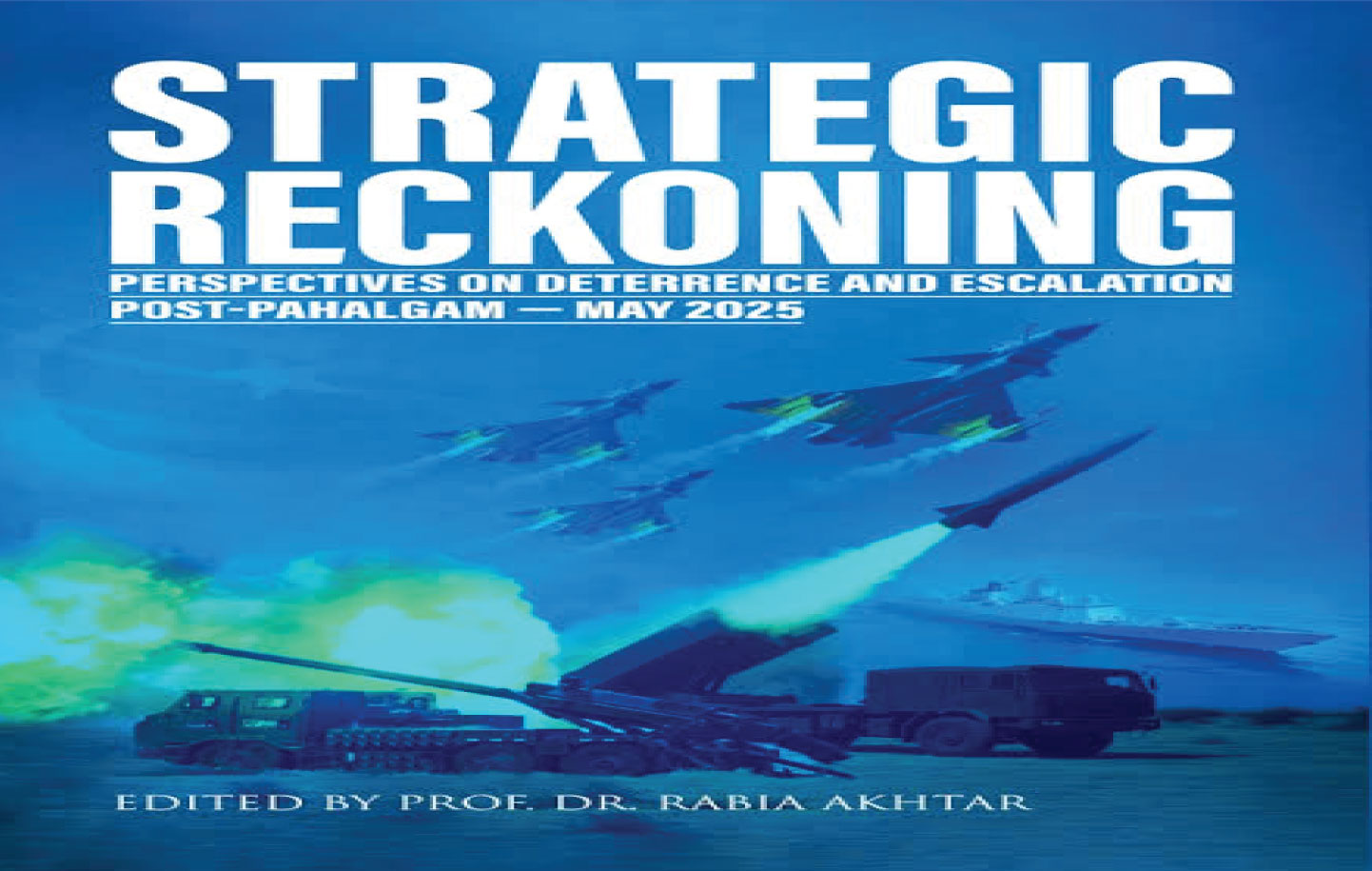
The book, titled Strategic Reckoning: Perspectives on Deterrence and Escalation Post-Pahalgam-May 2025, is edited by Prof Dr Rabia Akhtar, a leading Pakistani scholar and strategic analyst specializing in nuclear security, strategic stability, and South Asian security affairs. Prof Akhtar is Dean of the Faculty of Social Sciences at the University of Lahore and is associated with its Center for Security, Strategy and Policy Research (CSSPR) there. Her previous book, titled The Blind Eye: U.S. Non-Proliferation Policy Towards Pakistan from Ford to Clinton, was published in 2018.
Her new book brings together top strategic minds of Pakistan to analyze how the India-Pakistan May 2025 crisis post-Pahalgam, often referred to as the Four Days War, redefined nuclear deterrence in South Asia. The book is published by CSSPR and the Institute of Regional Studies (IRS), Islamabad. The preface of the book is written by Lt Gen (Retd) Khalid Ahmed Kidwai, Advisor National Command Authority. He discussed the dramatic change in rethinking and realignment in international politics following the 80-90 hours skirmish and how India fell out of Western grace. He termed the imposition of tariff on India and collapse of alliance as a ‘self-inflicted’ blow owing to the poor handling of Operation Sindoor fallout. Resultantly, what India is facing today is the outcome of its arrogant conduct as a state. He also commended the creation of Army Rocket Force Command by Pakistan Army as an operational necessity. It raised nuclear threshold by separating conventional missiles from nuclear delivery systems. The main argument of the book is firm rejection of India’s aggressive posture that Indian strategists claim to be a ‘new normal,’ the author calls it ‘new abnormal’ that threatens to institutionalize brinkmanship under nuclear shadow. It calls for responsible deterrence and restraint as a pathway towards lasting stability. To find a more stable equilibrium, Pakistan is advised to update its doctrines, strategies, and narratives in accordance with existing realities. The book is divided into twenty chapters and a preface. The first chapter introduces the Four Days War and Pakistan’s successful operationalization of Full Spectrum Deterrence (FSD). It explores how Pakistan’s response to India’s reckless bravado was based on responsible deterrence: a strategy of restraint by design, credible retaliation and rigorous crisis management. The book argues that South Asian deterrence is in flux, and the risk of miscalculation is rising.
The context and military lessons from 2025 are discussed in the first four chapters, where Ambassador Sardar Masood Khan traces the May 2025 crisis to the abrogation of Article 370 and 35A by India in August 2019. He argues that the US-India strategic partnership, India’s membership of QUAD and its recognition as a “net-security provider” along with the impunity for its aggressions against Muslims, Christians and whatever it did in Indian Illegally Occupied Jammu and Kashmir (IIOJK) emboldened India and led to the May crisis. He highlights the need to resolve the lingering issue of Kashmir to eliminate the persistent threat of escalation in South Asia. Lt Gen Aamer Riaz explores how Pakistan’s doctrine of Quid Pro Quo Plus developed in response to growing irrationality in Indian behavior. India under BJP has no intentions of resolving the dispute or even sitting down for normal diplomacy. Air Commodore (Retd) Khalid Banuri analyzed the military lessons in the air power domain. He explains how Pakistan Air Force achieved air superiority and how it was a masterclass in the execution of multi-domain warfare. Pakistan’s Defensive Counter Operation turned into an Offensive Counter Operation following the first Indian weapon that crossed Pakistani airspace, leading to the shooting down of six Indian fighter jets, including three Rafales, and the grounding of the Indian air force for 48 hours. Rear Admiral (Retd) Faisal Ali Shah shed light on the role of Pakistan Navy in the May 2025 conflict, and how they prevented it from spreading into the maritime domain. Pakistan Navy used preemptive deployment and updated information about the Indian navy as keys to its deterrence.
The next three chapters discuss cross-domain deterrence and strategic stability, where Dr Atia Ali Kazmi explains how Pakistan retaliated in the grey zone, such as the cyber domain, information warfare and psycho-ops. She analyzed how Pakistan used Electronic Warfare (EW) to degrade India’s situational awareness in the May 2025 crisis. She also cautioned that there is a need to rethink deterrence in a multi-domain context as warfare has become more complex and multifaceted. Dr. Naeem Salik argues that with advanced conventional capabilities, the stability-instability paradox has taken on new dimensions. For strategic stability in South Asia, there is a need to manage multiple interlocking factors, including nuclear doctrines, conventional force postures, emerging technologies and space and information domains. Ambassador Zamir Akram argues that the conflicts between Pakistan and India were de-escalated by third-party mediation. Pakistan and India should institutionalize the logic of restraint rather than relying on last-minute luck. He recommended reviving hotlines and water treaty mechanisms.
The subsequent chapters discuss the doctrines and narratives that shaped the strategic behavior of each side. Dr Adil Sultan rejected Indian strategists’ claim that Pakistan’s nuclear redlines are a bluff. He highlighted that Pakistan’s FSD posture should continue to deter India and make even a limited surgical strike cost prohibitive for India. Dr Zafar Nawaz Jaspal analyzes the strengths and gaps in Pakistan’s defenses during the May 2025 escalation. He appreciated how Pakistan’s conventional forces effectively countered the Indian offensive. He also raised concerns that Islamabad cannot be complacent, as New Delhi could initiate hostility and strike deep into Pakistani territory. He calls for reimagining conventional deterrence by further improving readiness, mobility and technology. He suggested investment in AI-enabled surveillance and Directed Energy Weapon Systems. He also highlighted an urgent need for Pakistan to counter psychological warfare by India. There is a need to invest in strategic communication units, think tanks and national, regional and international media engagements. Dr Zahir Kazmi argues that regional stability is degraded by India’s posture-policy dissonance. The erosion of India’s No-First-Use (NFU) doctrine and counterforce readiness also have implications for global nuclear norms. South Asia needs greater clarity and restraint in doctrine, not more ambiguity that could lead to fatal miscalculations. Ejaz Haider scrutinizes the role of Indian media and how it hyped the conflict. For short-term gain, these ‘politics of spectacle’ served the Indian government’s agenda but in the long run, it could be a double-edged sword, creating domestic pressure on leaders. It could lead to further escalation of the conflict than intended. He argues that responsible media discourse is another piece of maintaining peace. Dr Rizwana Abbasi further explores the narrative warfare, highlighting that under Modi’s leadership, Indian strategic culture leaned on an external enemy narrative to gain domestic electoral advantages and to justify military force.
The last seven chapters discuss the regional and global implications of India’s new abnormal. Ambassador Jauhar Saleem shed light on how India’s strategic partnership with the United States, along with its proclaimed title of ‘net-security provider’, emboldened India in its strategic arrogance towards the region. In the aftermath of May 2025, regional states recalibrated their external alliances and neighborhood strategies to reduce vulnerability to India’s coercive posturing. Furthermore, the May 2025 crisis reinforced Pakistan’s stance regarding India’s coercive strategic shift, willing to risk escalation for political and strategic signaling. Dr Salma Malik in her chapter explores the spillover effect of India-Pakistan rivalry in the South Asian region, including refugee influx, economic shocks, and radiation risks in case of nuclear escalation. She advocates for greater regional diplomacy and multilateral crisis management mechanisms to prevent normalization of conflict in South Asia. Dr Rizwan Zeb views the suspension of the Indus Water Treaty as the weaponization of a resource that would affect millions of ordinary people. India is using water as a tool to pressurize Pakistan and could inflict long-term economic and environmental harm. It has broadened the scope of deterrence that is not only about bombs and bullets, but also about preventing an enemy from turning vital civilian lifelines into bargaining chips. Dr Sharreh Qazi emphasizes that South Asia needs to strengthen its own crisis off-ramps, as relying on third-party mediation is not a sustainable option in a changing global landscape. Therefore, a regional mechanism or at least a bilateral crisis management understanding is essential to de-escalate the crisis. Malik Qasim Mustafa argues that India has eroded the established norms of mutual restraint and bilateral diplomacy. In this scenario, deterrence becomes more precarious as each side is left guessing what the other might do, and worst-case assumptions fill the gap. He calls to rebuild those strategic norms. Syed Ali Zia Jaffery comparatively analyzed India’s compellence signaling and Pakistan’s focus on reestablishing stability. He emphasizes the need for a grammar of deterrence in South Asia, a shared understanding of communication methods and interpretations in crisis. Dr Rabia Akhtar in the concluding chapter addresses how Indian strategic doctrine drifted into a more aggressive and risk-acceptance mode. She argues that the next decade would likely be defined by an intensified arms race as the old deterrence equilibrium collapsed. She chalked out the way out for a more stable equilibrium by rethinking deterrence, updating our strategies, doctrines and narratives in accordance with present realities. One that de-incentivizes misadventure, guarantees security to all sides, and also allows space for dialogue on issues that drive conflict.
Strategic Reckoning is a timely and rigorous analysis of the changing dynamics of deterrence in South Asia. It deconstructs the May 2025 India-Pakistan crisis through various dimensions, including air, naval, military, cyber, AI, media and narrative warfare, and psychological warfare. It also addresses its implications for the region as well and chalks out ways to restore deterrence in South Asia. The book is a must-read for policymakers, strategists and students of International Relations, Strategic Studies and Peace Studies, providing an in-depth analysis of the strategic, political and regional landscape of South Asia. The book examines the crisis from Pakistan’s perspective, fostering a more nuanced understanding of the dangers at hand and encouraging a candid dialogue on avoiding future conflict.