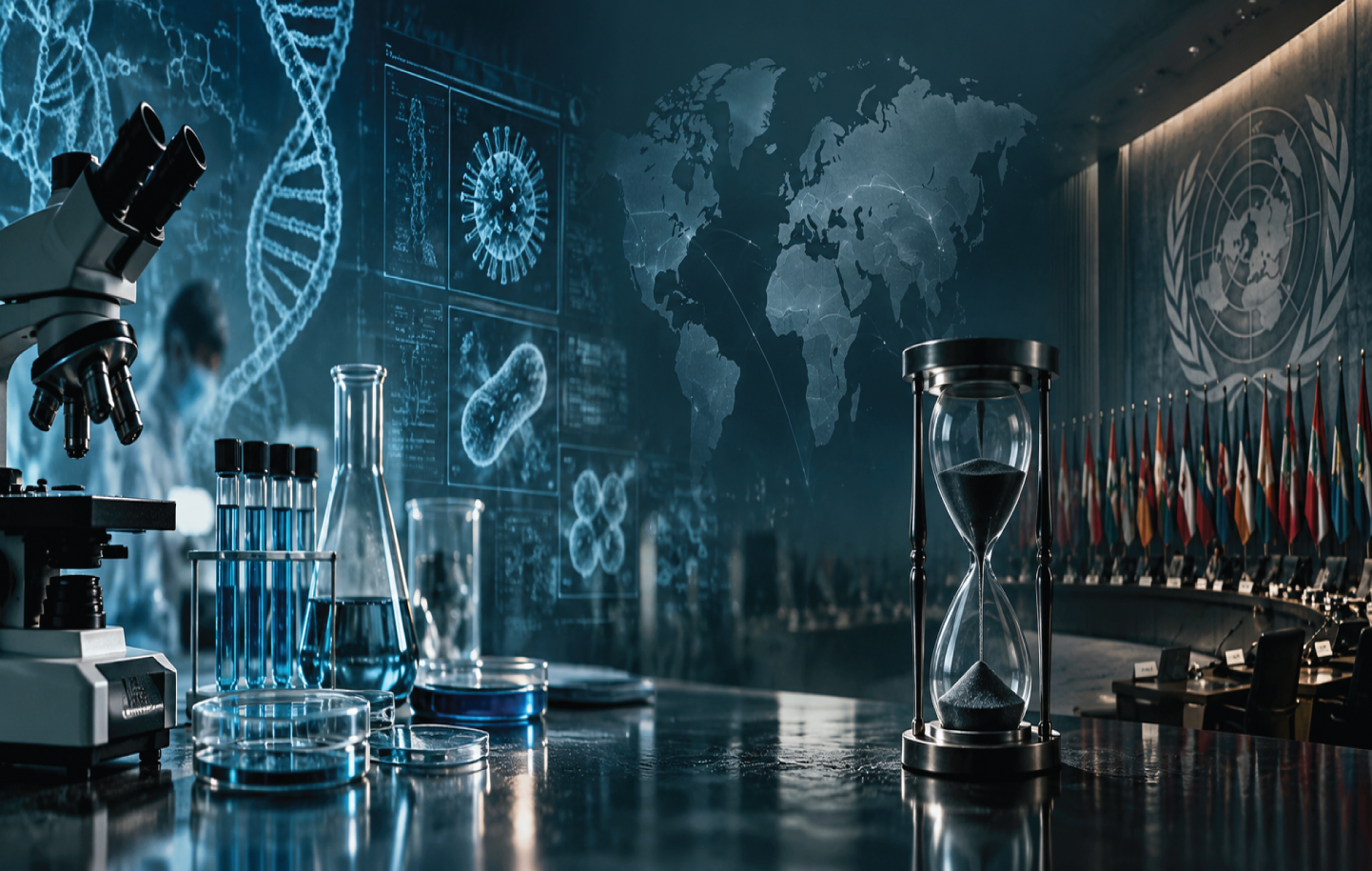
Biological science is adopting pace quicker than the regulations that were to have governed it. That can be one of the foremost challenges of the Biological Weapons Convention (BWC) in the future.
By the time the BWC was adopted in 1972, the biological landscape that the whole world was operating in was very different. The primary worry was the creation and possession of the biological weapons by states. Nowadays, the image is much more complex. Research in synthetic biology, gene editing, artificial intelligence and laboratory automation are making new opportunities unlock that were hard to envision just several decades prior.
The benefits associated with these developments are huge. They are able to enhance medicines, enhance the surveillance of the disease, assist agriculture and aid countries to respond to the outbreak. However, new security risks can also be developed with the help of the same scientific advancement. It is in this case that the BWC has an issue that should be given more precedence; the rules are not only necessarily evolving as the science.
It is not a new issue that states are already struggling with this challenge as seen in the recent debates by the BWC Working Group on fortifying the Convention. The questions about science and technology, international cooperation, and technology transfers, export controls, implementation and verification on a national level all tend to the same field: how can an agreement developed in the previous century be re-enforced in a world of fast-changing technologies?
Creating additional restrictions will not be the solution. Another type of biological threat. Biological risk is in itself evolving. Previously governments could pay much attention to the programmes and facilities of the biological weapons. Biological research today is being done in the world with great importance in universities, private laboratories, biotech companies as well as research institutions.
This puts in a challenging divide. It is usually not the individuals who comprehend what the future of biological technologies will be, who are engaged in negotiating tables. They are employed in laboratories, at universities and companies. It may take many years before a new technology comes into the spotlight, and scientists are convinced that it has potential, before governments even start thinking about its security aspects.
In other words, the BWC should be much more closely tied with the scientific community. The science and technology review process it does should not merely inform governments on the things which have already occurred. It must assist them to comprehend what can occur next.
It is so especially since the production of biological technologies can proceed at a broth. What is an experimentally new technique today could be a commonplace technique tomorrow. A feature previously only able to be accessed with specialised facilities might be less expensive and accessible.
Governments might be too late in case they pay enough attention to the technology only when it becomes an apparent threat to their security.
One more problem which cannot be overlooked is the disparity between the existence of such biotechnology-enhanced countries and economies that lack such opportunities.
This introduces an article X of the BWC. The paper also envisages international collaboration and support of peaceful application of the biological science. In recent negotiations, there have been various differences amongst states on the magnitude of the presence of Article X, but without diluting the other obligations of the Convention. In the case of the developing countries, this is not a non-wholesome debate.
The availability of science and technology may translate to better disease diagnosis, a healthier public-health system, increased agricultural output and scientific prowess. It would be counterproductive to request countries to enhance biological security and leave them without the means to establish laboratories, educate scientists or come up with some sort of viable regulatory framework. Weak scientific institutions of a country do not always imply a safer country.
In most instances the converse might hold true. A well prepared nation is one that has strong laboratories, educated scientists to carry out biosafety practices and good disease surveillance to detect and contain biological threats.
Resourse to international cooperation, therefore, cannot be considered as an issue of development only. It is also a security concern. The aim must be to access responsibly – they can enjoy a peaceful scientific development, but the right protection must be there.
There is also the issue of the verification, long-standing with the BWC as well. Biological research is a hard nut to crack due to the fact that the same facilities and scientist knowledge can be employed in the peaceful and even hazardous intentions. An infectious disease working lab may have apparatus and capabilities which in a different scenario would be abused.
This ensures that biological verification is distinctly different to the traditional arms-control verification. It is not the answer to declare all research laboratories as potential weapons sites. Neither can the international community afford to place all their trust.
It is an approach toward more sensible unitary practice of implementation, openness, trust measures, conscientious research methods and valid systems of dealing with worries. It should focus on developing confidence in the abilities of countries to control biological capabilities in a responsible way.
The space between science, industry and diplomacy, is perhaps the crucial gap. Governments negotiate international agreements and most of the biotechnology formulating the future is developing outside the government institutions. This does not imply that international security policy is to be made by the private companies or scientists. States are expected to be accountable with regard to their BWC commitments.
However, governments cannot make wise decisions on technologies which they lack know-how. Scientists and policymakers must have a dialog on a regular and substantive basis. The industries and research institutions must also have a way through which the new developments can be debated prior to it becoming a security issue. The BWC must not just be aware of what is going on in biology today, but in what direction biology is moving.
The second stage of discussions gives a chance to discuss this problem. The purpose to make rules of every possible scientific development should not be of the goal. It would be unrealistic. Science will never take the same paths that can not be fully predicted by the policymakers.
Rather the BWC should be made more flexible. It requires a framework that has the ability to recognize promoted technologies at the embryonic stage, assist nations to make their nation stronger, assist responsible scientific collaboration and foster increased confidence amongst states.
Above all, it must shorten the response time between the identification of a new risk and the response towards it. Probably the most valuable reform is that. By the time the BWC was developed, the world had been able to perceive bio threats as mainly being viewed through the prism of state weapons programmes. The future will be more perplexing. Biological capabilities will be bound to cross-national as well as inter-institutional and sectoral lines and the traditional way of doing things will be increasingly difficult to use.
This however, does not render the Convention irrelevant. It makes it rather significant. The world community is yet to have a strategic world standard against biological weapons. The result of that change is that science now requires a system of governance capable of holding that norm up.
The question to states is not so clear as how to watch the biological weapons of nowadays. Whether these can give rise to a system that can identify the biological challenges of tomorrow in terms of security before these challenges turn to be a crisis is whether. Science will not relax until governments have come to terms. The BWC can not afford either. It might also no longer be the most difficult to control biological weapons. It may be closing the growing gap between the speed of science and the speed of international governance.