Nearly a year after the Pahalgam crisis and the subsequent four day military engagement between India and Pakistan, its broader implications for South Asian strategic stability are clearer. The episode did not merely represent another limited confrontation between two nuclear armed neighbors. It tested long standing doctrinal assumptions, particularly regarding escalation control and the viability of limited war under a nuclear overhang. In retrospect, the crisis appears to have reinforced Pakistan’s deterrence posture while raising serious questions about the feasibility of India’s evolving coercive strategy.
India’s military response following the Pahalgam incident reflected a doctrinal trajectory visible in its strategic discourse over the past decade. Indian planners have increasingly explored the possibility of calibrated conventional operations below Pakistan’s nuclear threshold. The underlying objective has been to create operational space for punitive strikes while avoiding full scale escalation.
This approach draws conceptual parallels with models employed in other regions, particularly in the Middle East where technologically superior Israel conducts military operations against weaker or non-state actors. However, the structural conditions in South Asia differ fundamentally. Pakistan maintains a credible nuclear deterrent, supported by an established command and control architecture and a conventional force posture designed specifically to prevent limited war doctrines from gaining traction.
The May 2025 crisis demonstrated the limits of escalation management when both sides possess significant retaliatory capabilities. Attempts to operationalize a limited conflict framework encountered resistance not only at the tactical level but at the strategic signaling level as well. The engagement suggested that conventional maneuvering under a nuclear umbrella remains far more constrained than some Indian doctrinal writings had assumed.
Pakistan’s response, formally designated Operation Bunyan ul Marsoos, was calibrated to achieve specific strategic objectives. The operational design appeared focused on three elements: restoration of deterrence credibility, imposition of proportional military costs and prevention of uncontrolled escalation.
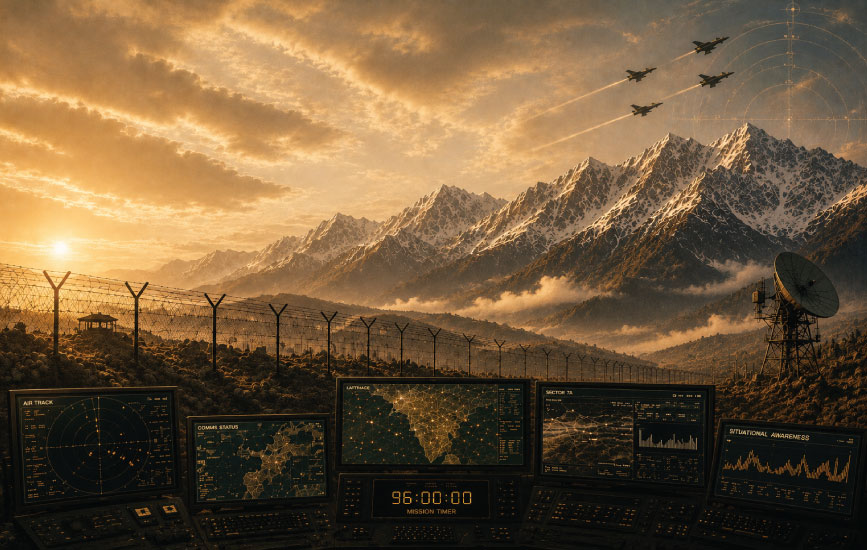
The reported downing of six Indian aircraft and one UAV during the engagement became a focal point of military analysis. Beyond the immediate tactical impact, the aerial exchanges challenged assumptions regarding air superiority and survivability in a contested environment. The episode underscored the importance of integrated air defense, pilot training and networked battlefield awareness in high intensity but time bound engagements.
The strategic communication aspect of Operation Bunyan ul Marsoos was equally noteworthy. Pakistan’s military leadership communicated clearly, consistently and credibly throughout the crisis. Every claim Pakistan made was subsequently verified and validated, enhancing its credibility on the international stage in ways that would pay significant diplomatic dividends in the months that followed.
The crisis also had important political consequences, particularly regarding the status of Kashmir. Since the revocation of Article 370, India has maintained that the region has entered a phase of normalization and integration. The Pahalgam incident and the subsequent escalation pierced that facade with considerable force.
The attack in a high visibility tourist area drew renewed international attention to the region’s underlying security dynamics. International media coverage, policy discussions in Western legislatures and statements by human rights organizations collectively reinserted Kashmir into global discourse. The scale of security deployment, recurring restrictions on political activity and documented human rights concerns became subjects of wider scrutiny and a source of considerable embarrassment for New Delhi.
For Pakistan, this shift aligned with its long held diplomatic position that Kashmir remains an internationally recognized dispute rather than an internal administrative matter. While no immediate structural change occurred in the dispute’s status, the crisis substantially diluted the perception that the issue had been conclusively settled following the constitutional changes of 2019.
The diplomatic aftermath of the crisis revealed sharply contrasting trajectories. Pakistan moved quickly to frame its response as defensive and proportionate, emphasizing restraint after establishing deterrence. This messaging found resonance among several key partners.
China reiterated strong political support and expanded strategic coordination with Islamabad. Turkey, Saudi Arabia, Azerbaijan and the United Arab Emirates expressed support for Pakistan’s position. The Organization of Islamic Cooperation issued statements implicitly criticizing India’s military adventurism. Even countries that traditionally maintained balanced positions between India and Pakistan found themselves tilting toward Islamabad given the observable contrast between Indian escalation and Pakistani restraint.
Russia, traditionally regarded as an Indian strategic partner, adopted a notably more neutral position than New Delhi would have preferred. Moscow’s expanding economic relationships with Pakistan, combined with its own regional calculations, meant that India could not count on unconditional Russian support as it once might have.
India, for its part, faced a considerably more complex diplomatic environment. The exaggerated claims made during and immediately after the military engagement, claims that were systematically dismantled by independent analysis, satellite imagery and open source intelligence, created a credibility gap that has proven difficult to bridge. When a state loses credibility on matters of military fact, that erosion of trust tends to spread into broader diplomatic domains.
India’s aspiration to be recognized as a major global power and a viable counterweight to China in Asia has consequently receded. Countries that New Delhi counted among its friends distanced themselves not out of hostility but out of concern about India’s judgment and reliability as a strategic partner. The European Union adopted positions on Kashmir deeply uncomfortable for New Delhi. ASEAN nations grew cautious rather than supportive.
The diplomatic friction extended even to Washington, where the response fell notably short of the strategic endorsement New Delhi had anticipated. While the State Department publicly advocated for bilateral restraint, the private diplomatic channel was reportedly far more critical of India’s escalatory trajectory. U.S. officials emphasized that military experimentation against a nuclear armed state presented unacceptable risks to global stability, signaling that American strategic partnership did not constitute a blank check for regional coercion.
This diplomatic discomfort was compounded significantly by the rhetoric of the Trump administration. President Trump made repeated public remarks that directly undermined the official Indian narrative, specifically referencing the number of aircraft lost in the engagement. His persistent assertions regarding his personal role in mediating the crisis and his public offer to arbitrate the Kashmir dispute struck at the heart of India’s foundational bilateralism doctrine.
These statements placed the Modi government in a deeply awkward position domestically, providing opposition parties with pointed ammunition to challenge official claims of strategic success and exposing the gap between government messaging and international perception.
Perhaps the most consequential and least anticipated outcome of the past year has been Pakistan’s transition from a regional actor to a significant player in global diplomacy. Pakistan’s calibrated military response and its subsequent emphasis on de-escalation fundamentally altered how key international capitals assess Islamabad’s strategic maturity. This newfound credibility, rooted in a demonstrated capacity for restraint under provocation, has opened diplomatic doors that were previously inaccessible.
Most notably, Pakistan has emerged as a credible intermediary in managing tensions between the United States and Iran, a role with profound implications for global energy security and Middle Eastern stability. This is a remarkable elevation in diplomatic standing for a country like Pakistan. While New Delhi remains largely absent from these critical transnational conversations, global attention has increasingly centered on Islamabad as a constructive and rational actor.
The contrast is strategically significant. India’s regional assertiveness has narrowed its diplomatic reach while Pakistan’s measured conduct has broadened its international role in ways that extend well beyond South Asia.
As the one year mark approaches, several conclusions emerge with reasonable clarity.
First, the crisis reaffirmed that conventional military superiority does not automatically translate into strategic advantage when the adversary possesses a credible nuclear deterrent and the operational capability to impose meaningful costs. India’s force size could not compensate for doctrinal miscalculation.
Second, nuclear deterrence demonstrated its stabilizing function even under active engagement. Pakistan’s arsenal did precisely what deterrence theory prescribes. It constrained escalation and preserved strategic equilibrium.
Third, narrative credibility proved to be a genuine strategic asset. Pakistan’s consistent and verifiable communication throughout the crisis enhanced its international standing while India’s overstated claims generated a credibility deficit with lasting diplomatic consequences.
Fourth, the Kashmir dispute has demonstrated a resilience that administrative and constitutional measures alone cannot suppress. India’s attempt to reframe an internationally recognized dispute as a settled internal matter has not withstood the scrutiny that the crisis generated. Any durable stability in South Asia will ultimately require engagement with the political aspirations of the Kashmiri people rather than their administrative suppression.
Taken together, the Pahalgam crisis and its aftermath represent a significant inflection point in South Asian strategic dynamics. The outcomes of the past year suggest that coercive doctrines have structural limits in a nuclearized environment and that diplomatic credibility, once lost, is not easily recovered. For Pakistan, the episode has validated core strategic assumptions. For India, it has exposed the distance between strategic ambition and strategic reality.