

Key Takeaways:
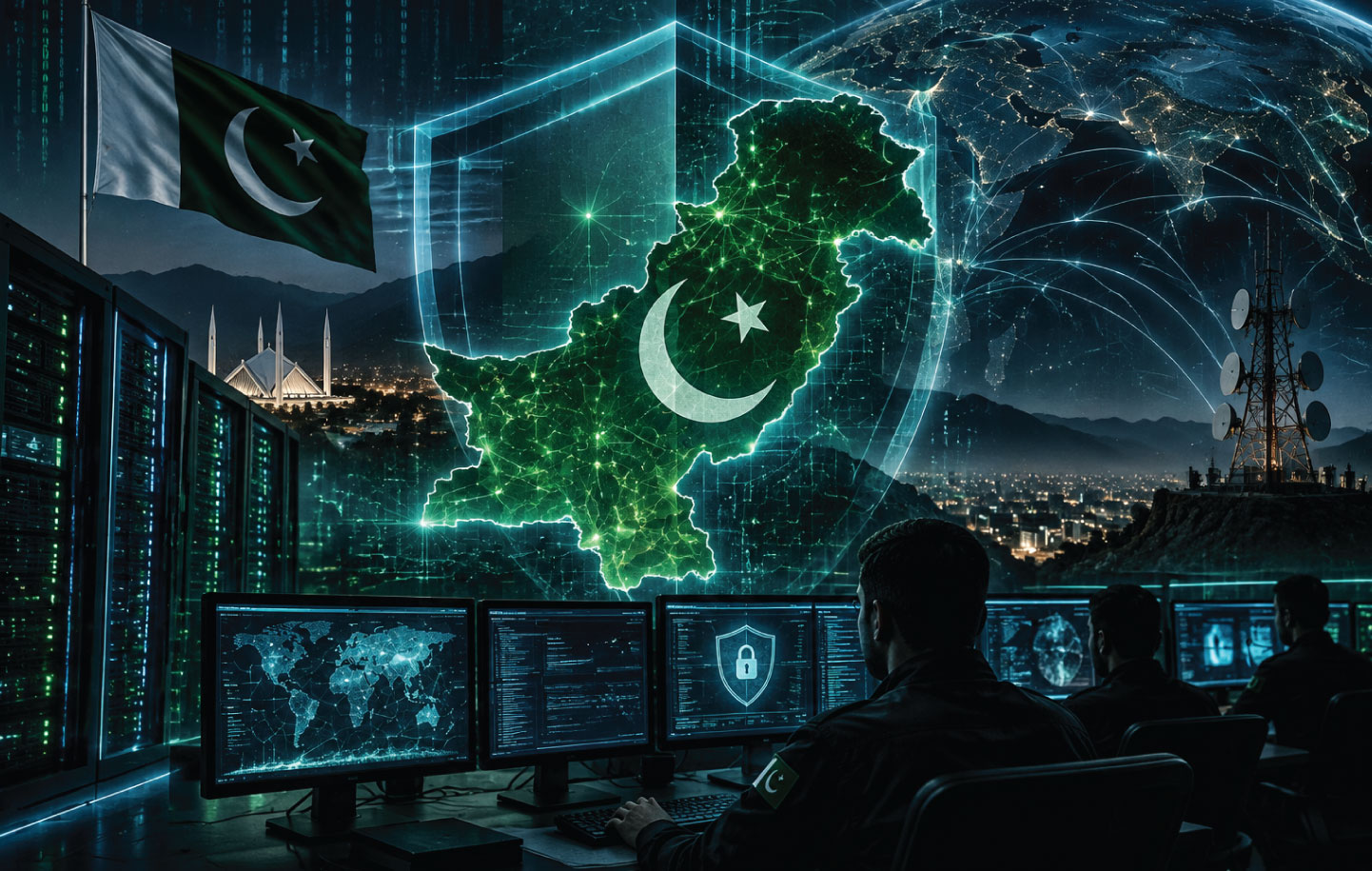
- On 14 Aug 2026 Pakistan opened a National Cyber Security Operations Centre under National CERT to monitor and respond on government and critical systems—the piece treats cyber as national resilience, not just IT, after digital records, finance, and infrastructure became reachable without a physical border.
- Cited pressure includes a July 2026 report of alleged India-linked espionage (2024–April 2026) on police in Balochistan, KP, and Islamabad and the Punjab Safe Cities Authority; attribution fog in a nuclear South Asia could turn an incident into crisis uncertainty.
- Next steps: tie NCSOC to the 2026 Information Security Framework, sector standards (telecom, banks, energy, health), talent and national exercises, and treat cyber in high-level crisis planning plus transnational cooperation without surrendering digital sovereignty.
Pakistan’s growing dependence on digital systems is quietly changing the country’s security landscape. Government records, financial transactions, communications, public services and critical infrastructure are increasingly connected through networks that can be targeted from outside the country without a single physical border being crossed. What makes this shift particularly important is that a cyberattack today can have consequences far beyond cyberspace. It can expose sensitive information, disrupt essential services and, during a crisis, create uncertainty that directly affects national security.
Pakistan’s digital transformation has created enormous opportunities for economic growth, public services and connectivity. At the same time, greater dependence on digital systems has created new vulnerabilities. Cyber threats can now extend beyond the theft of information. They can disrupt essential services, compromise sensitive institutions, collect strategic intelligence and create uncertainty during periods of political or military tension.
The good news is that Pakistan is increasingly recognising this changing landscape and building institutions to respond to it.
A significant development came on 14 August 2026, when Pakistan inaugurated the National Cyber Security Operations Centre (NCSOC) under the National CERT. The centre is intended to strengthen real-time monitoring, detection and response to cyber threats, particularly those affecting critical infrastructure and government systems. This development represents an important step in Pakistan’s efforts to strengthen its national cyber-security architecture.
The significance of the NCSOC goes beyond the establishment of another cyber-security institution. It reflects an important shift in thinking: cybersecurity is no longer simply an information-technology issue; it is becoming an essential element of national resilience.
The Changing Nature of the Threat
Cyber warfare has evolved considerably. The traditional image of a cyberattack often involves a hacked website, stolen passwords or financial fraud. Today, the strategic consequences can be much broader.
Cyber espionage can provide access to sensitive government information. Attacks on communications networks can affect the functioning of institutions. Disruption of financial systems can create economic consequences, while attacks against critical infrastructure can potentially affect everyday life.
Recent developments have reinforced this concern. A July 2026 investigation reported that cyber-espionage campaigns linked to groups associated with India had targeted Pakistani law-enforcement institutions between 2024 and April 2026. The reported targets included police organisations in Balochistan, Khyber Pakhtunkhwa and Islamabad, as well as the Punjab Safe Cities Authority.
The importance of such incidents lies not simply in the loss or compromise of information. When institutions responsible for public safety and internal security become targets, cyber activity acquires a direct national-security dimension.
Pakistan therefore needs to look at cyber threats not only in terms of individual incidents but as part of the wider security environment.
Building Resilience, Not Just Responding to Attacks
No country can realistically expect to prevent every cyber intrusion. The objective should instead be to build systems that can withstand attacks, identify them quickly, contain their effects and recover without major disruption.
This is where the idea of cyber resilience becomes important.
For Pakistan, resilience means ensuring that an attack on one institution does not create a wider national crisis. It requires secure systems, trained personnel, effective coordination and the ability to maintain essential services even during a cyber incident.
The establishment of the NCSOC can contribute significantly to this objective. Its effectiveness, however, will depend on how well it connects with the wider national-security and civilian infrastructure.
Cyber threats do not follow institutional boundaries. A telecommunications attack can affect emergency services. A compromise of a government database can create intelligence risks. A disruption to financial networks can have economic consequences. Critical infrastructure, therefore, cannot be protected through isolated efforts.
Pakistan needs an integrated approach in which government institutions, critical infrastructure operators, telecommunications companies, financial institutions, academia and the technology sector contribute to a common national cyber-resilience framework.
Strengthening Cyber Governance
Another important development is Pakistan’s Information Security Framework 2026, developed through the National CERT. The framework seeks to establish baseline information-security requirements and strengthen risk management, auditing, incident response and continuity planning.
Such measures are important because national cyber security cannot depend entirely on specialized institutions. Every organization connected to a country’s critical digital infrastructure can potentially become part of its security chain.
The implementation of common security standards can therefore help Pakistan move towards a more consistent national approach.
However, frameworks are only as effective as their implementation. Cybersecurity requirements must be accompanied by regular assessments, institutional accountability, professional training and adequate resources.
The objective should be to develop a culture in which cybersecurity is considered a fundamental component of governance rather than an issue addressed only after an incident occurs.
Cyber Warfare and Pakistan’s Strategic Environment
Cyber warfare also has wider implications for Pakistan’s strategic environment.
South Asia remains one of the world’s most sensitive security regions. India-Pakistan relations are characterized by longstanding political tensions, military competition and the presence of nuclear weapons. In such an environment, cyber operations can introduce an additional layer of uncertainty.
One of the most difficult aspects of cyber conflict is attribution. It may not always be immediately clear who is responsible for an attack, what the objective was or whether an incident represents criminal activity, espionage or state-sponsored action.
During a crisis, this uncertainty can become particularly dangerous.
A cyber incident affecting government networks, military communications or critical infrastructure could create confusion at precisely the moment when decision-makers require reliable information.
For this reason, Pakistan should increasingly incorporate the cyber domain into its broader understanding of strategic stability and crisis management.
Cyber resilience is not separate from national defence. It is becoming part of it.
The Way Forward
Pakistan has made important progress, but institutional development must now be accompanied by a broader national strategy.
First, coordination must remain a priority. The NCSOC, National CERT, relevant government institutions and critical infrastructure operators should operate through clearly defined channels for information sharing and incident response.
Second, Pakistan should strengthen protection of critical infrastructure. Telecommunications, banking, energy, transport, health and government services require sector-specific security standards and regular assessments.
Third, investment in people is essential. Cyber resilience ultimately depends on skilled professionals who can detect threats, investigate incidents and restore systems. Pakistan’s universities and research institutions should therefore play a greater role in developing cybersecurity expertise.
Fourth, Pakistan should conduct regular national cyber exercises. Simulated attacks on critical sectors can identify weaknesses in coordination and response before a real incident exposes them.
Fifth, cybersecurity should become part of national security planning at the highest level.Cyber risks should be considered alongside conventional military, economic and information-security threats rather than being treated as a separate technical matter.
Finally, Pakistan should continue constructive international cooperation. Cyber threats are inherently transnational. Cooperation in capacity building, information sharing, digital forensics and responsible state behaviour can strengthen Pakistan’s security without compromising its national interests or digital sovereignty.
From Cyber Vulnerability to Strategic Resilience
Pakistan’s challenge is not simply to defend its networks from hackers. It is to protect the functioning of the state in an environment where conflict and competition increasingly extend into cyberspace.
The inauguration of the NCSOC and the development of the Information Security Framework 2026 demonstrate that Pakistan is moving in the right direction. The next step is to connect these initiatives into a comprehensive national approach to cyber resilience.
Pakistan should not approach cyberspace only from the perspective of vulnerability. It should approach it from the perspective ofpreparedness, resilience and strategic capability.
The digital domain is becoming an increasingly important arena of national power. States that can protect their networks, maintain essential services and recover quickly from disruption will be better positioned to safeguard their sovereignty and strategic interests.
For Pakistan, strengthening cyber resilience is therefore not merely about protecting computers and networks.
It is about protecting the continuity, credibility and security of the state in the digital age.