

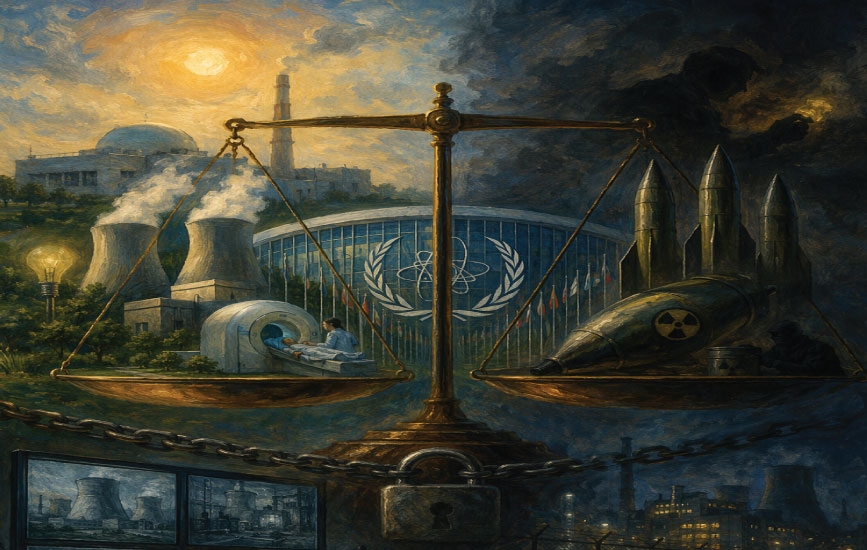
A robust, impartial, and universally applied safeguards regime remains indispensable, as the line between peaceful nuclear development and military capability continues to erode.
The “Atoms for Peace” policy, introduced by Dwight D. Eisenhower in the 1950s, constituted a seminal initiative that fundamentally reoriented global perceptions of nuclear technology. It marked a transition from an exclusive emphasis on military destructiveness towards the promotion of civilian applications.
While the initiative successfully catalysed the development of nuclear medicine and civilian nuclear power industries, critics contend that it inadvertently facilitated the diffusion of sensitive technological knowledge and materials, thereby enabling several states to develop nuclear weapons and accelerating nuclear proliferation subsequently.
Notwithstanding these concerns, the policy directly contributed to the establishment of the International Atomic Energy Agency in 1957, an institution that continues to oversee nuclear activities and enforce safeguard mechanisms worldwide.
A significant number of nuclear weapons programmes have historically evolved under the guise of civilian nuclear initiatives, thereby rendering the role of the International Atomic Energy Agency increasingly critical in delineating the boundary between military ambitions and developmental objectives in nuclear technology.
In this context, recent remarks by Rafael Mariano Grossi merit closer scrutiny. He commended the Prototype Fast Breeder Reactor (PFBR) located in Kalpakkam, India, acknowledging the “impressive progress” achieved in this advanced third-generation reactor.
During engagements at the World Economic Forum 2026 in Davos, Grossi further reiterated the Agency’s willingness to support India’s ambitious objective of expanding its nuclear capacity to 100 GW by 2047.
Given the increasingly blurred distinction between the militarisation and civilian utilisation of nuclear technology, all such initiatives must be subjected to comprehensive IAEA safeguards.
However, it is noteworthy that India has explicitly declined to place the PFBR under the IAEA’s safeguard regime. New Delhi has consistently resisted international inspection of its breeder programme, invoking “strategic interests”—a term widely interpreted as a reference to its nuclear weapons programme.
Since the PFBR operates outside the purview of IAEA safeguards, unlike India’s civilian Pressurised Heavy Water Reactors (PHWRs), it remains unverified by the Agency. Consequently, there exists no independent mechanism to ensure that plutonium produced within the reactor is not diverted for military purposes.
India has historically maintained several nuclear reactors outside the IAEA’s monitoring framework. At present, eleven nuclear reactors remain unsafeguarded, with two additional units under construction.
This raises profound concerns for global non-proliferation efforts and undermines the principles of a rules-based international order. Such opacity has triggered alarm among stakeholders, as it potentially signals questionable strategic intent.
In this context, the statements made by the IAEA Director General risk creating a permissive environment in which states may restrict IAEA access while still receiving international endorsement. This development not only heightens the risk of a renewed arms race but also poses a significant challenge to regional strategic stability.
From a technological standpoint, the transition to breeder reactor technology has historically encountered substantial obstacles, even in technologically advanced states such as the United States, France, and Japan.
The use of liquid sodium as a coolant presents considerable operational hazards, as evidenced by the shutdown of reactors such as Superphénix and Monju following incidents involving leaks and fires.
Critics further argue that the PFBR design may lack adequate safeguards against “core disassembly accidents”, which could result in significantly higher energy releases compared to conventional reactors.
India’s PFBR is ultimately intended to utilise Thorium-232 as part of its long-term nuclear strategy; however, it does not employ thorium as its primary fuel during initial operational stages.
Thorium-232 is widely regarded as a “fertile” material capable of producing a cleaner, safer, and more sustainable energy source. Unlike Uranium-235, which is relatively scarce, thorium is estimated to be three to four times more abundant in the Earth’s crust and can be almost entirely utilised.
Nevertheless, the practical realisation of thorium-based energy systems remains decades away. The PFBR constitutes only the second phase of India’s three-stage nuclear programme. At the same time, the third stage—commercial-scale thorium utilisation—remains technologically elusive and fraught with challenges that may take decades to overcome.
Consequently, assertions regarding the near-term viability of thorium energy may be considered overly optimistic.
Endorsement of such a project, particularly in a region characterised by strategic sensitivities, may prove counterproductive. This is especially pertinent given India’s contested nuclear track record and documented concerns regarding nuclear material security.
The commendation by the IAEA Director General risks creating a “commitment trap” for both India and the Agency, particularly in light of the project’s protracted delays spanning over sixteen years.
India has historically maintained several nuclear reactors outside the IAEA’s monitoring framework. At present, eleven nuclear reactors remain unsafeguarded, with two additional units under construction.
Notably, while Tarapur-1 has undergone refurbishment and Tarapur-2 is scheduled for similar upgrades under IAEA safeguards, India continues to operate safeguarded and unsafeguarded reactors within the same facility.
The combination of unsafeguarded nuclear infrastructure, recurring incidents of nuclear material diversion, and limitations in regulatory independence amplifies concerns regarding strategic stability in South Asia.
This raises critical questions regarding the criteria employed by Indian authorities in determining the applicability of safeguards. Given the historical role of unsafeguarded facilities in both horizontal and vertical proliferation, the selective application of safeguards warrants rigorous scrutiny.
Absent a transparent rationale, such practices risk being interpreted as facilitating broader strategic ambitions.
The situation is further exacerbated by recurring reports of nuclear material theft within India. Although Indian authorities assert that their nuclear security mechanisms are robust, international observers and regional stakeholders have repeatedly expressed concerns regarding the emergence of a potential nuclear black market.
Documented incidents date back to the 1980s, with over twenty reported cases of theft or smuggling of nuclear-related materials between 1994 and 2024.
In August 2024, law enforcement authorities in Bihar apprehended three individuals in possession of 50 grams of californium, a highly radioactive substance valued at approximately $100 million. Similarly, in July 2024, five individuals were detained in Dehradun with a radioactive device allegedly originating from the Bhabha Atomic Research Centre.
Comparable incidents were reported in 2021 across multiple regions, including Maharashtra, Jharkhand, and Kolkata, involving the seizure of significant quantities of uranium and related materials.
India has a total of eleven (11) unsafeguarded nuclear reactors, including two (2) under construction. Their details are as follows:
1. Madras Atomic Power Station (Kalpakkam) – 3 reactors
a. Madras Atomic Power Plant-1 and 2 (220 MW each)
b. Prototype Fast Breeder Reactor (500 MW)
2. Kaiga Generating Station – 6 reactors
a. Kaiga Atomic Power Project 1, 2, 3 and 4 (220 MW each)
b. Kaiga Atomic Power Project 5 and 6 are under construction (700 MW each)
3. Tarapur Atomic Power Station – 2 reactors
a. Tarapur Atomic Power Plant 3 and 4 (540 MW each)
Tarapur-1 has been refurbished, and Tarapur-2 will be refurbished shortly. Both these reactors are under IAEA safeguards.
It is noteworthy that India is operating safeguarded and unsafeguarded nuclear reactors at the same facility.
The frequency and consistency of such incidents suggest the presence of insider threats and their potential linkages to a lucrative nuclear black market.
Furthermore, the absence of a fully independent nuclear regulatory authority in India undermines effective oversight. The existing Atomic Energy Regulatory Board operates under the Department of Atomic Energy, thereby raising questions regarding institutional autonomy and accountability.
According to the Nuclear Threat Initiative Nuclear Security Index 2023, India ranked 20th out of 22 states possessing weapons-usable nuclear materials, highlighting deficiencies in physical protection, material accounting, and auditing mechanisms.
This performance represents a persistent concern for regional security, particularly for Pakistan. As a responsible state actor, Pakistan has consistently called for enhanced oversight by the IAEA, characterising these recurring incidents as a threat to regional stability and a potential source for the construction of “dirty bombs” by non-state actors.
It is noteworthy that only in the SHANTI Act 2025 was the Atomic Energy Regulatory Board (AERB) granted full statutory independence for the first time. India historically lacked comprehensive national requirements for nuclear facility cybersecurity.
Moreover, recurring local thefts of radioactive material (such as uranium and californium) suggest gaps in domestic tracking and local law enforcement. India is a signatory to the CPPNM and its amendment, committing to protect nuclear material in peaceful domestic use and transport.
However, India is unable to act as a responsible nuclear state.
Inherent contradictions remain evident in contemporary proliferation challenges. The case of India’s Prototype Fast Breeder Reactor underscores the persistent ambiguity between civilian and military nuclear pursuits, particularly when critical facilities remain outside the safeguards framework of the International Atomic Energy Agency.
While international endorsement of nuclear expansion may be framed as support for clean energy and technological advancement, the absence of transparency and verification mechanisms risks undermining the credibility of global non-proliferation norms.
Moreover, the combination of unsafeguarded nuclear infrastructure, recurring incidents of nuclear material diversion, and limitations in regulatory independence amplifies concerns regarding strategic stability in South Asia.
In this context, statements by Rafael Mariano Grossi risk setting a precedent that could weaken the normative authority of the IAEA by implicitly legitimising selective compliance.
A robust, impartial, and universally applied safeguards regime remains indispensable to maintaining a rules-based international order. Without consistent enforcement and transparency, the line between peaceful nuclear development and military capability will continue to erode, increasing the risk of proliferation and destabilising already fragile regional security dynamics.